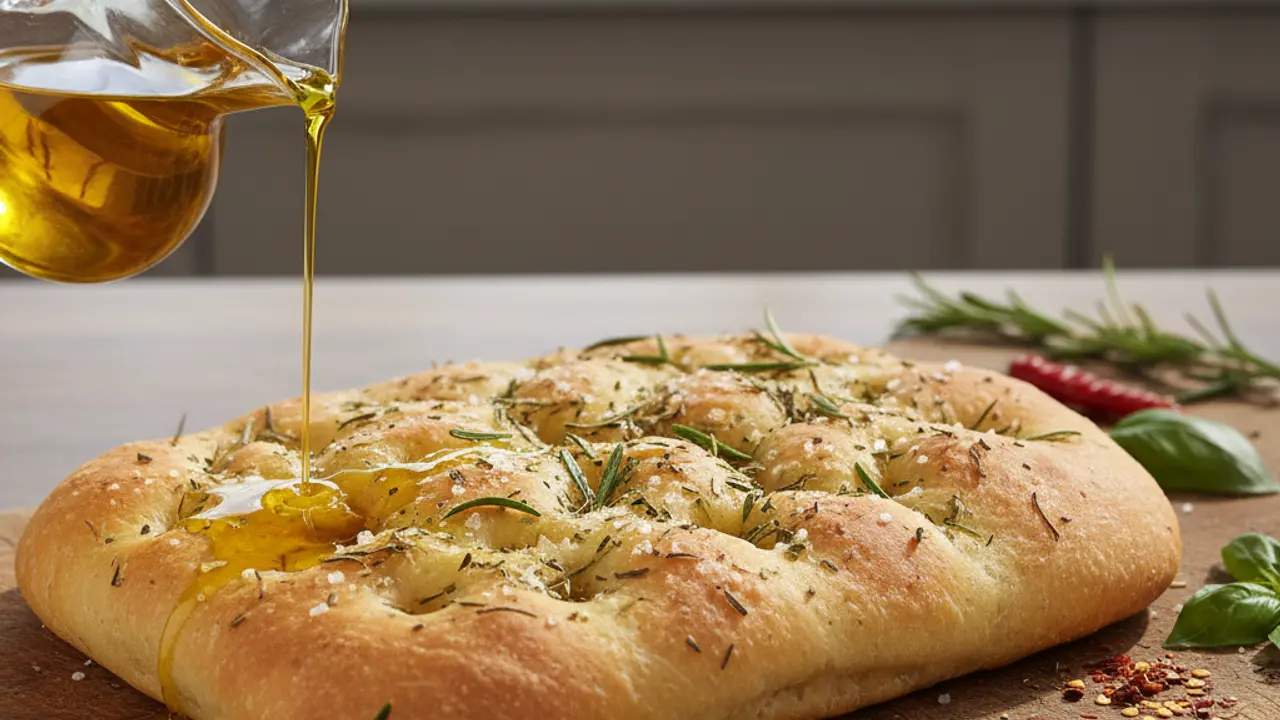
Analyzing traditional focaccia - what is inside?
Discover the nutritional values of a portion of traditional focaccia and compare it with another meal.
Our friends at Eendje spotted it: everyone wants traditional focaccia again. We've counted the calories.
Let's look up traditional focaccia in Nilou.
I search for the dish in the list. Found it, with the unit portion. These are the values per portion. Added to your log. Traditional focaccia (homemade).
My takeaways
The structure of this dish
I immediately see that the total is divided into 4. The largest contribution comes from wheat flour and olive oil.
wheat flour (77 %), olive oil (22 %), dry yeast (1 %) largely determine the character.
Where the numbers come from
I notice that the fat mainly comes from olive oil. For the protein, wheat flour provides the largest share.
Each portion uses 530 to 650 kcal of energy. That asks for a smart layout of your day.
What a portion brings you
Every portion contains 14 g of protein and 96 g of carbohydrates. Along with that comes 0.4 g of sugar and 16 g of fat.
A smaller portion or a different preparation changes these numbers instantly. This way you easily adjust it to your moment.
Comparison in practice
This dish takes 530 to 650 kcal per portion. That is comparable to a plate of spaghetti bolognese of 540 to 650 kcal.
Keep track of your own portion and discover how it fits into your day.
How I worked it out
Each ingredient shows the amount from the recipe, with values from the USDA table.
| Ingredient | Grams | kcal | Protein | Carbs | Of which sugar | Fat |
|---|---|---|---|---|---|---|
| wheat flour | 500 | 1820 | 51.7 | 381.6 | 1.4 | 4.9 |
| water | 350 | 0 | 0 | 0 | 0 | 0 |
| dry yeast | 7 | 23 | 2.8 | 2.9 | 0 | 0.5 |
| salt | 10 | 0 | 0 | 0 | 0 | 0 |
| olive oil | 60 | 530 | 0 | 0 | 0 | 60 |
| Whole recipe | 927 | 2373 | 54.5 | 384.5 | 1.4 | 65.4 |
| Per portion (1/4) | 232 | 593 | 13.6 | 96.1 | 0.4 | 16.4 |
With a 10 % margin, I get 530 to 650 kcal per portion.
I open Nilou with the dish already typed in; nothing is logged until you tap the dish yourself.
Sources and method
This is an estimate, not medical advice. I use a reference of 60 to 85 kg and values from the USDA table.
- USDA FoodData Central, SR Legacy (april 2018), fdc_id 168894: Wheat flour, white, all-purpose, enriched, bleached
- USDA FoodData Central, SR Legacy (april 2018), fdc_id 173647: Beverages, water, tap, drinking
- USDA FoodData Central, SR Legacy (april 2018), fdc_id 175043: Leavening agents, yeast, baker's, active dry
- USDA FoodData Central, SR Legacy (april 2018), fdc_id 173468: Salt, table
- USDA FoodData Central, SR Legacy (april 2018), fdc_id 171413: Oil, olive, salad or cooking
- USDA FoodData Central, SR Legacy (april 2018), fdc_id 169736: Pasta, dry, enriched
- USDA FoodData Central, SR Legacy (april 2018), fdc_id 171790: Beef, ground, 95% lean meat / 5% fat, raw
- USDA FoodData Central, SR Legacy (april 2018), fdc_id 171192: Sauce, pasta, spaghetti/marinara, ready-to-serve
- USDA FoodData Central, SR Legacy (april 2018), fdc_id 170848: Cheese, parmesan, hard